
Introduction
Normalisation and weighting is a method for aggregating life cycle impacts across several environmental impact indicators into a single score. It can be employed to facilitate better understanding of environmental damage across impact categories that are either abstract, or that have non-intuitive reference units. Grouping is a further optional step for sorting impact indicators into sub-categories prior to weighting and aggregation.
Several rating schemes utilise normalisation and weighting, including BREEAM (BRE), ISv1.2 & ISv2.0 (ISC), and Green Star Buildings (GBCA) for calculating EcoPoints, EnviroPoints and Life Cycle Impacts, respectively.
Normalisation
ISO14044 defines normalisation as: “calculating the magnitude of category indicator results relative to reference information”, as such, normalisation converts the raw environmental impact values for each indicator to their impact relative to the selected reference point.
A commonly selected reference point is the average per capita environmental impact over a year – this could be globally, nationally, or across a region. Thus, normalisation is often used to express the environmental impact of a good or service (or construction project) relative to the environmental impact of a single person across the selected set of environmental indicators. To enable comparison with benchmarks or other studies, generally it is the impacts per functional unit that are normalised.
Other potential reference points could be industry or sector specific emissions, but it is also valid to normalise “internally”. Internal normalisation is a comparison between a reference product or reference model within the same study e.g., between a proposed building design and an equivalent business as usual building design. Note that the normalised impact figures have no units.
Normalisation:
Normalised Impact = Raw Impact / Normalisation Factor
Weighting
ISO 14044 defines weighting as: “converting and possibly aggregating indicator results across impact categories using numerical factors based on value-choices”, as such, weightings can be applied to normalised indicator values based on how relatively important they are deemed to be. The normalised and weighted indicators can then be added up into a single aggregated environmental impact score that can be used for decision making purposes.
Weighting:
Normalised and Weighted Impact = Normalised Impact x Weighting Factor
Grouping
Grouping is an optional step that can be used to sort environmental impacts by various characteristics. For example, indicators could be grouped based on geographical impact i.e. global scale impacts, and regional scale impacts, or into impact categories such as ecological impacts, human health impacts, and resource use impacts. Grouping indicators prior to weighting can be useful for rationalising disparate, or large numbers of environmental impacts into fewer or more relatable categories.
Table 1. Examples of Impact Category Grouping

Normalisation and Weighting Factors
Table 2: Bre EcoPoints Normalisation and Weighting Factors

Table 3: Green Star Buildings (Australia) Normalisation and Weighting Factors

Table 4: ISv2.0 (ISC) Normalisation and Weighting Factors
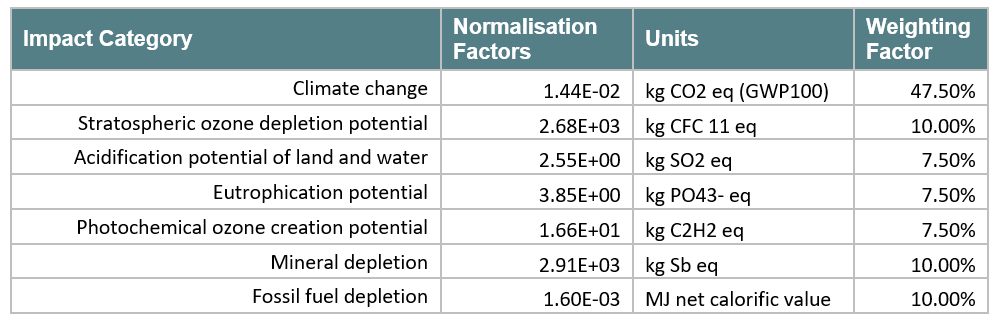
Table 5: ISv1.2 (ISC) Normalisation and Weighting Factors

Normalisation and Weighting Example
In this example we compare the impacts of two example buildings (A & B), using the Green Star Buildings normalisation and weighting factors.
Table 6: Normalisation and weighting of example building A impacts.

Table 7: Normalisation and weighting of example building B impacts.
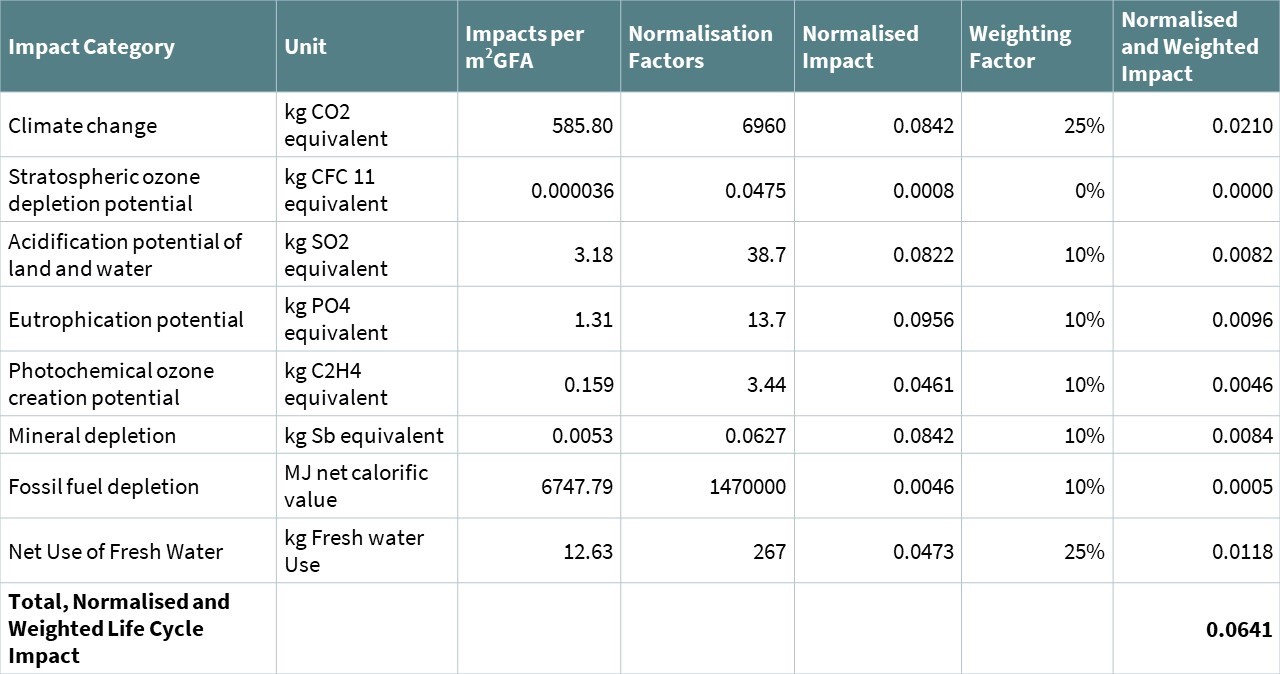
After normalisation and weighting, the total life cycle impacts of building A are 0.0799, and of building B are 0.0641. As such, using these normalisation and weighting factors it would be concluded that building B has lower overall life cycle impacts than building A.

How are the ISC V1.2 and 2.0 data verified? Are they audited figures or aligns with any standards?
Hi Arindam,
Thank you for your question. Yes, we conduct a data alignment exercise with the ISC data which is also verified by ISC. You can read more about ISC on the following posts:
What’s the difference between the ISCA material’s calculator and eTool?
Using eTool for ISC RSO-6 Credit and Environmental Modelling of Infrastructure Projects